Time Line
Romans 50 BC to 450 AD at Trimontium, Saint Columba 521 to 557AD Saint Cuthbert 635 to 687AD Newstead Village the oldest Village in Scotland possible 10th Century Ledgerwood Chuch first record 1127 but dates back to the 11th Century. The Knights Templers who brought Free Masonery 14th century
The Scottish Borders has a time line going back 2000 year from the Romans to present day.
The history of St Columba
Saint Cuthbert
The Knights Templar
Saint. Columba (born c. 521, Gartan [in County Donegal, Ireland]-died June 8/9, 597, Iona [Inner Hebrides, Scotland]; feast day June 9) is an Irish saint who is credited with having had a main role in the conversion of Scotland to Christianity in the 6th century. He is a patron saint of Scotland and one of the three patron saints of Ireland, along with St. Patrick and St. Brigid. He is also revered as the patron of the city of Derry, Northern Ireland; poets; and bookbinders and is invoked against floods. Columba and his associates and successors spread the gospel more than any other contemporary group of religious pioneers in Britain.
Columba is believed to have been born in the civil parish of Gartan in what is now County Donegal, in the northwest of Ireland. Folk tradition states that he was born on December 7, 521, and that this was a Thursday (a day associated with luck in Scottish folklore), though many of the details of his birth have been contested by scholars. He is believed to have been the son of noble parents and a descendant of Niall of the Nine Hostages, who founded the great Uí Néill dynasty in the 4th century. His baptismal name, Colum, comes from columba, the Latin word for dove. His Irish name, Colm Cille, means "dove of the church."
Columba studied in Ireland under Saints Finnian of Moville and Finnian of Clonard and was ordained a priest about 551. He founded churches and the famous monasteries Daire Calgaich (Derry) and Dairmagh (Durrow). He also established a religious community at Ceanannas Mór (Kells).
About 563 Columba and his 12 disciples traveled by currach (a small boat with a wooden or wicker frame covered over in tarred animal hides) to the island of Iona in the Inner Hebrides. Some legends claim that Columba's departure from Ireland was a self-imposed exile undertaken as penance for several actions that led to a war between two Irish tribes. This war was supposedly the culmination of a long dispute between Columba and Finnian of Moville over Columba's having secretly made a copy of Finnian's illuminated Psalter. Columba's transgression prompted judicial action by a king, who ruled in Finnian's favor with the pronouncement, "To every cow her calf, so to every book its copy." Notoriously headstrong, Columba refused to accept the judgment. The dispute escalated and drew in other authority figures, resulting in the Battle of Cúl Dreimhne (in what is now County Sligo), which took thousands of lives. Deeply remorseful for all the bloodshed he had caused, Columba decided to leave Ireland.
Regardless of his true reasons for emigrating, Columba and his 12 disciples decided upon Iona as their springboard for the conversion of Scotland. The religious community that was established there was regarded as the mother house and its abbots as the chief ecclesiastical rulers even of the bishops. Columba gave formal benediction and inauguration to Aidan MacGabrain of Dunadd as king of Dalriada.
Columba accompanied Aidan to Ireland (575) and took a leading part in a council held at Druim Cetta, which determined the position of the ruler of Dalriada in relation to the king of Ireland. The last years of Columba's life appear to have been spent mainly in Iona, where he was already revered as a saint. Excavations on Iona in 1958 and 1959 revealed Columba's living cell and the outline of the original monastery. Different traditions claim that he is buried on Iona or in Saul, a village in the former County Down in Northern Ireland, alongside Saints Patrick and Brigid. Both sites have become places of pilgrimage.
Three Latin hymns may be attributed to Columba with some degree of certainty, and there are a number of Irish poems ascribed to him. Several of the saint's relics, including a bell and a crozier, are housed at the National Museum of Ireland. The Iona Community, an ecumenical religious community comprised of laypersons and clergy, was founded in 1938 to carry on the spirit of Columba's mission. The group has performed valuable restoration of the island's monastic ruins and hosts services at the renovated Iona Abbey. A pilgrimage path known as Slí Cholmcille (the St. Columba Way) was established in the 21st century in Ireland and Scotland. The path features several trails that follow important sites in the saint's life.
Saint Cuthbert
In his lifetime, Cuthbert (635-687) was an influential churchman who was Prior of Melrose a chapel he built along with followers of Saint Columba,, thats old Melrose which lies under Scotts view 3 miles from here, and then of Lindisfarne. He was a venerated religious figure, and a successful preacher who was responsible for the spread of Christianity in the North of England. After his death, his grave in Lindisfarne, and the places to which his incorrupt body was subsequently moved - Chester Le-Street and Ripon - became the greatest focus of pilgrimage in early medieval England until the death of Thomas Becket in 1170. Cuthbert's body has been in Durham since 995, and the grave is still a shrine to which pilgrims travel.
The Knights Templars officially were no more but their knowledge that didn't burn with them Legends say that templers didn't die they went underground some believe they became sacred knowledge into a new age others claim they fled to Scotland bringing Free Masonery with them.
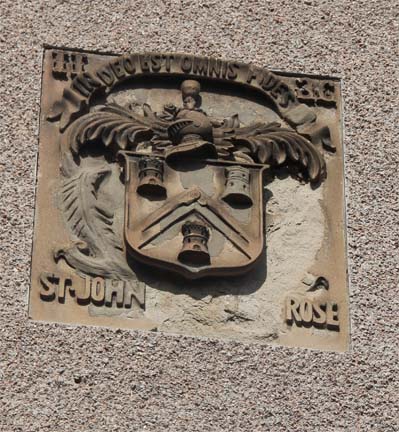
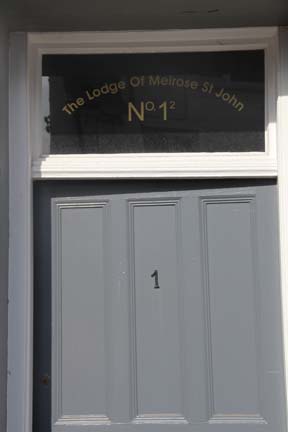
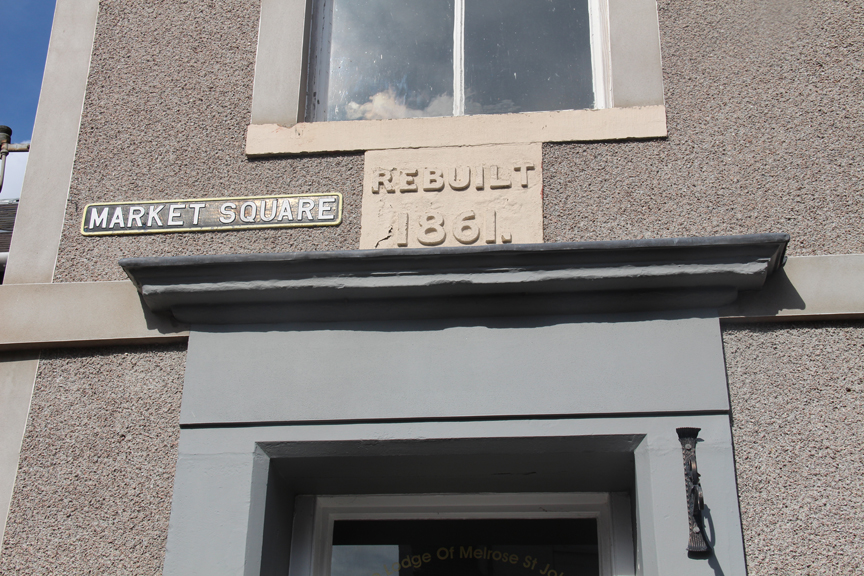
Below you will see lodge number 1 plus a small 2 after it. Free Masons believe lodge 1 was in Mussleburgh and this was lodge 1 plus 2 in Melrose, it can be seen half way down Melrose high street on the right
Why is Cuthbert Important?
In his life, Cuthbert's importance lay in his role as a preacher and hermit. Accounts of his life show that he embodied the values of humility, simplicity and tolerance, and he must have been revered as a model Christian. He is also reported to have performed many healing miracles and was treated as a saint upon his death.
Eleven years after his death, it was discovered that Cuthbert's body was incorrupt. This, along with miracles associated with the shrine, led to the blossoming of a pilgrimage cult that was unrivalled in Britain for almost five hundred years.
Find out more about Cuthbert's Life
Cuthbert's Early Life
Although tradition says that Cuthbert was the son of an Irish king, it is most likely that he was born in the vicinity of Melrose (in present-day Scotland) in 633. Certainly, we know that he guarded sheep on the hills above the abbey when he was older.
Cuthbert's Calling
The young Cuthbert may have been influenced by the nearby monks of Melrose Abbey (Old Melrose) in his choice of vocation; when he was about eighteen he had a vision of the soul being carried to heaven by angels and the next day he learned of the death of St Aidan, the first Bishop of Lindisfarne. This vision may have convinced him to enter holy orders at Melrose, but he did not rush to fulfill his calling.
Instead, Cuthbert spent several years as a soldier, probably in the service of the Kingdom of Northumbria against the attacks of King Penda of Mercia. After that conflict had ended, Cuthbert entered the monastery at Old Melroe Melrose, where his devotion earned him high praise. When a monastery at Ripon was founded, it was Cuthbert who was chosen to be its master.
Cuthbert's Melrose Abbey was raided in 839 and then fell into ruin. It was refounded as a Cistercian abbey in 1134, three miles from its original site, Old Melrose under Scotts View, because the land was better for farming there. It was then destroyed and reconstructed several times, but alas, stands in ruin today.
© Jeremy Atherton 2004
Roman versus Celtic
These were years of conflict between the traditions of the Celtic Rite and the Roman Rite in the Catholic Church. In 661 Ripon decided to adopt the Roman approach. Being adherents of the Celtic Rite, Cuthbert and his followers returned to Melrose. Three years later, following the death of his mentor, Prior Biosil, Cuthbert was chosen to succeed him.
An Accommodating Mind
Cuthbert's reign as prior did not last long; in that same year of 664, the Synod of Whitby settled the ongoing dispute between Roman and Celtic Christianity in favour of the former. Cuthbert acquiesced with the Synod's decision, and adopted Roman rule. He was sent to the Priory of Lindisfarne to ease the transition to Roman tradition there.
A Leader for Change
Cuthbert was a perfect choice for such a sensitive role; his reputation for devotion and sanctity, and the fact that he himself had been raised in the Celtic tradition and now supported Roman rule made his gentle leadership ideal for the job at hand. He spent a great deal of his time at Lindisfarne evangelizing among the people of the area, and exercising the tact and patience for which he was known to lead the conversion to Roman Christianity.
A Retreat to Solitude
Cuthbert's time at Lindisfarne was short, however. He desired the peace of a life of contemplation, and in 676 was granted leave to retire to take up the simple life of a hermit. Just where Cuthbert chose for his retreat is uncertain. Some traditions say that the rocky islet of St Cuthbert's Island, near Lindisfarne, was the spot. Other traditions place him in St Cuthbert's Cave, near Howburn. In any case, he did not stay long, and soon moved to Farne Island, opposite Bamburgh, which was more remote.
A Return to Action
After several years of austere life on Farne, Cuthbert was reluctantly persuaded to return to a more active role in the Church, and became Bishop of Lindisfarne. His consecration was held at York on Easter, 685. He returned to Lindisfarne, but his time was short. By Christmas 686 he felt his death approach, and Cuthbert resigned his see and returned to Farne Island. He died on March 20, 687 and was buried on Lindisfarne.
Find out about Cuthbert's importance after his death.
The Knights Templar
THe Story of the knight's templar begins in the early 12th century during the height of the crusades. Founded to protect Christian pilgrims traveling to the holy land the Templar's quickly Rose to power becoming a military Force a religious order and the world's first multinational bank but with power came secrets whispers began to emerge that the Templars had discovered something extraordinary beneath the Temple of Solomon in Jerusalem something not meant for the eyes of Ordinary Men some say it was the Holy Grail others claim it was ancient texts even Relics from a Civilization lost to time but all legends agree the Templars had knowledge that could challenge the authority of kings and even the Pope they became untouchable their castles dotted Europe their wealth rivaled monarchs and their influence crept into Every Corner of Medieval Society but power breeds enemies in 1307 on Friday the 13th King Philip the fourth of France deep in debt to the Templars ordered their sudden arrest under torture many confess to heresy Idol worship and secret rituals some said they worship to mysterious head called baffomet other they spot on the cross denied Christ and practice rights in the Dark Truth or a political smear campaign to destroy a threat the last grandmasters burned at the stake in 1314 with his final breath he cursed the Pope in The King and both were dead within a year the Templars officially were no more but their knowledge that didn't burn with them Legends say that templers didn't die they went underground some believe they became sacred knowledge into a new age others claim they fled to Scotland protecting something someone Foundation of Christianity what was this forbidden knowledge some say it revealed the truth about Jesus Christ that he survived the crucifixion had Descendants and that the church had concealed it for centuries others believe that Templars uncovered ancient technologies mystical teachings from Egypt or Mesopotamia long lost to mankind whatever it was it was powerful enough to make Kings tremble even today Templar symbols appear in architecture currency and secret societies from the pentagon's layout to obscure markings in Ancient churches the echoes of their Legacy remain and perhaps there knowledge does too what do you think the Knights Templar truly discovered was it religious truth ancient technology or something the world still isn't ready for.
.
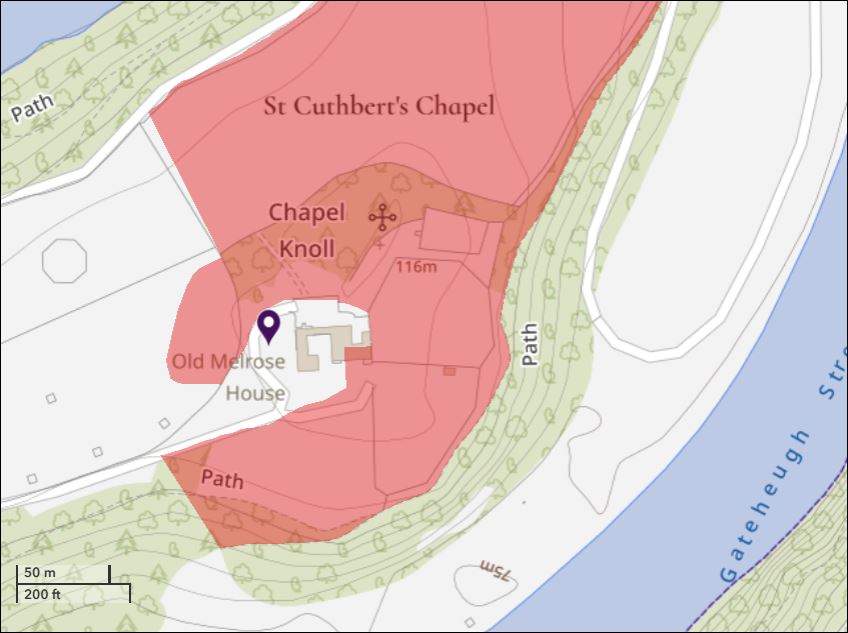
Below is a map of position of OLd Merose, the site of StCuthberts Chapel 700 AD